What a Catalina Foothills Home's Decade Tells You Before You Tour
November 26, 2026
The median Catalina Foothills sale went from $700,000 in the third quarter of 2022 to $729,000 in the third quarter of 2026. That's about 4% over four years, according to quarterly MLS figures for single-family homes and condos in the area. Through those same four years, every house behind the number kept aging on its own schedule. A burnt-adobe hacienda from the 1930s, a slump-block ranch from the 1960s and a stucco-and-tile home from the 1990s each wore differently.
The area median is holding nearly still, so the home's own condition and history decide most of what a buyer is paying for. In the Foothills, the decade a house was built is a good first predictor of its walls, its roof, its pipes and its windows. You can know it before you book a showing.
The quarterly numbers show the pattern. In the third quarter, the median close price was $700,000 in 2022, $699,000 in 2023, $713,000 in 2024, $723,000 in 2025 and $729,000 in 2026. The average close price moved more, from $759,000 in the 2022 quarter to $891,000 in the 2026 quarter, with a dip to $842,000 in 2025. When the average swings and the median hardly moves, the high end is shifting while the typical sale stays put.
Other windows show the same middle. MLS of Southern Arizona data for the twelve months ending October 31, 2026 put the Foothills median at $660,000 across 1,044 residential sales. Over that period, homes sold at a median 97.9% of their final list price, and the median time from listing to closing was 63 days. In October 2026 alone, 65 Foothills homes closed at a median $605,000. Each describes a market that isn't climbing quickly.
That matters for anyone thinking about an older house. If you buy a dated home planning to update it, appreciation won't cover much of the work. The cost has to come out of the purchase price. One local pricing guide from fall 2026 said a remodeled Foothills home and a dated one on a similar lot can sell hundreds of thousands of dollars apart. The decade a house was built tells you a lot about which side of that gap it falls on, and why.
The area wasn't built all at once. According to the Catalina Foothills Association's history, John Murphey bought a 7,000-acre tract north of River Road at a federal land auction in 1928. He and Helen Murphey planned ten subdivisions, each lot larger than three acres, laid out for privacy, desert vegetation and mountain and valley views. They partnered with Swiss-born architect Josias Joesler in the early 1930s, and construction on Catalina Foothills Estates began in 1935, northeast of Campbell Avenue and River Road. St. Philip's in the Foothills, founded in 1936 at that corner when both roads were still dirt, came out of the same partnership. It is on the National Register of Historic Places.
The Arizona Daily Star's account of how development shaped the Foothills dates the later waves.
| Era | Named places from that wave |
|---|---|
| 1930s to 1950s | Catalina Foothills Estates, Joesler homes, St. Philip's in the Foothills |
| Early 1960s | Skyline Country Club Estates; the private Skyline Country Club and golf course opened in 1963 |
| 1970s and 1980s | Rancho Sin Vacas, starting in the late 1970s; the non-gated Alta Vista, Cimarron Estates and Fairfield |
| 1980s | La Paloma Estates, Ventana Canyon Estates |
| 1990s | Cobblestone |
| 2000s | Sabino Mountain, Pima Canyon |
The same Star account says that by 2009 the Foothills had more than 20 gated communities, and new homes were going up higher on the steeper slopes near the Coronado National Forest. One community can still cover several decades. A Skyline-area guide describes homes there built from the 1960s through the 2010s, including burnt-adobe Territorial townhomes from 1967 to 1974 and the Mediterranean-style El Diamonte townhomes, with painted stucco and clay-tile accents, built from 1986 to 2000. The community name gives you the era range. The individual home's build date tells you more.
Joesler's Foothills houses relied on mortar-washed burnt adobe, stuccoed adobe and clay tile for floors and roofs, across a career in Tucson that ran from 1927 to 1956. Adobe walls need finishes that keep out moisture, and repair work done with the wrong materials can make damage worse. If you're touring a Joesler-era home, put an adobe specialist on the inspection list along with the general inspector.
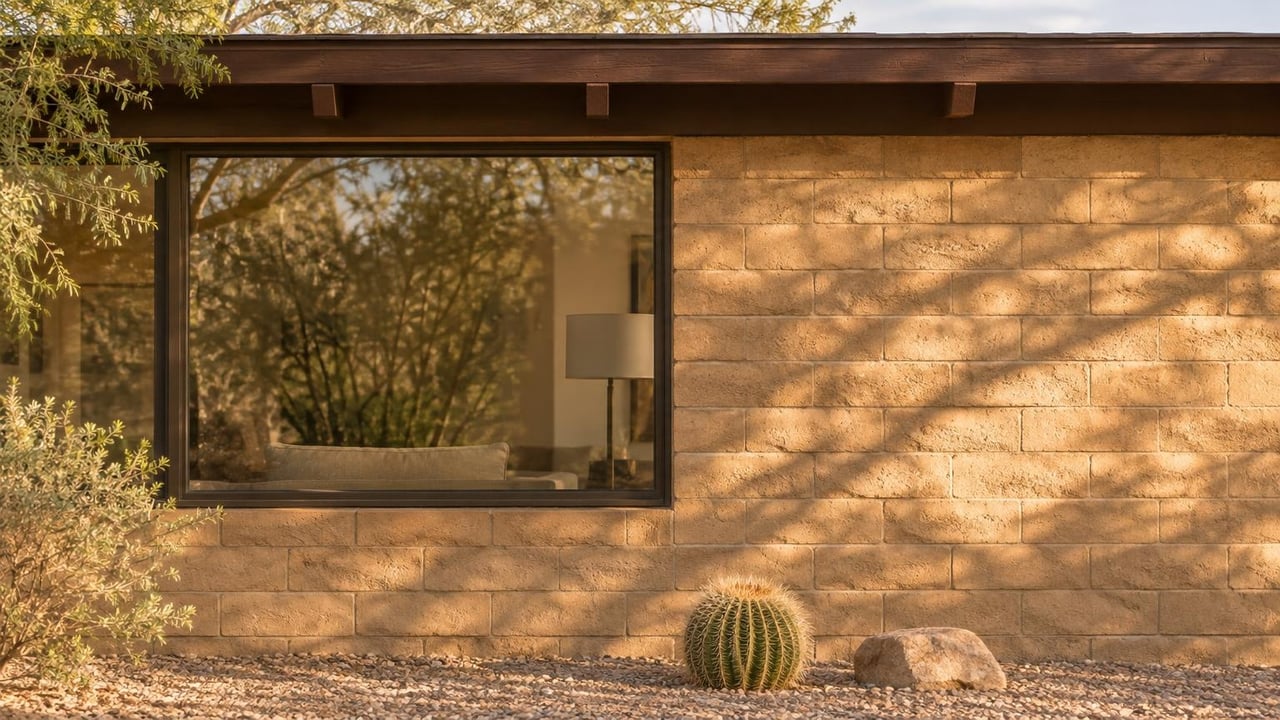
By the 1960s, burnt adobe and slump block were the most common wall materials in Tucson, according to a City of Tucson historic preservation study. The study says slump block held up better against moisture and was more structurally stable than burnt adobe. In late-1960s and 1970s production homes, some builders put slump block on the street-facing side and used wood framing on the other sides. So a house from that period can look like masonry from the curb and be a different building around back. A walk around all four sides tells you which one you're looking at.
Windows changed in the same years. The city study traces steel casement windows in the 1940s and early 1950s, aluminum sliders appearing in the mid-1950s, and aluminum windows and sliding doors used by nearly every builder by the early 1960s. The city's guide to green retrofitting historic homes says original steel casements can be reglazed with double panes rather than replaced. On a Joesler-era home, that can make a real difference in what the window line costs to update.
Flat roofs are where the Foothills views come from, and they come with a maintenance schedule. A City of Tucson study of postwar housing found built-up roofing was the most common flat-roof material, often topped with a layer of reflective gravel. Builders chose low-slope roofs partly for cost and partly to keep mountain views open.
A spray-foam roof is only as good as its coating. In a Rosie on the House feature in the Arizona Daily Star, the coating on a foam roof wears away at roughly one millimeter a year and should be recoated before it drops below 10 millimeters. The feature also says coating warranties run five years with two layers or 10 years with three, and that debris clogging the scuppers can leave water standing on the roof. Tucson roofer ABRC estimates 15 to 20 years for spray foam with a premium coating and 20 to 30 years for built-up roofing with a premium coating.
A 1960s house may have had its foam recoated two years ago, and a 1990s house may be on its original coating. The useful question for any flat roof in the Foothills is when it was last recoated and how many layers went on. Tile roofs need a different question, because the tile can last for decades while the underlayment beneath it wears out.
Plumbing ties most closely to the build date. AZ Pure Water & Plumbing, writing in November 2026, says galvanized steel pipe is common in Tucson homes built before the 1970s and can corrode from the inside, cutting water flow and discoloring the water. The same Tucson plumber dates common use of polybutylene pipe to roughly 1978 through 1995, says it can fail suddenly, and lists PEX as a current option for repiping.
Put those dates next to the table above. The galvanized period covers the Joesler homes and early Skyline. The polybutylene period covers late-1970s Rancho Sin Vacas, the Alta Vista, Cimarron Estates and Fairfield wave, La Paloma Estates, Ventana Canyon Estates and the early years of Cobblestone. That doesn't mean any particular house in those communities has either material, since many have been repiped. It means the question is worth asking for homes from those decades, and it matters less for a house built in Sabino Mountain or Pima Canyon in the 2000s.
Across the Foothills, homes sold close to their final list price during the twelve months through October 2026, at a median of 97.9%. Most negotiating happens before that final price is set. Tucson-wide, half of active listings had a price cut as of early November 2026. In October 2026, 41% of closed sales had been reduced at some point, and the reduced homes closed an average 9.9% below their original asking price. Those numbers cover all of Tucson, not only the Foothills.
Put that together with a flat Foothills median and the build decade becomes the most useful part of any comparison. If two Foothills homes are listed at the same price, one built in 1964 and one in 1988, you're comparing two different sets of materials. The 1964 house may have galvanized pipe and an aluminum window line. The 1988 house may have polybutylene pipe and a foam coating near the end of its life. Rising values won't make up the difference on either one. The roof records, the plumbing history and a walk around all four walls show what the asking price leaves out, and they're worth checking before you write an offer.
Mostly for the plumbing, since the polybutylene period ends around 1995. The roof still matters, because a foam coating wears down by about a millimeter a year whatever the house's age. Homes on the steeper sites in Pima Canyon and nearby communities raise their own site questions, which have more to do with the lot than the decade.
A local 85750 guide published in November 2026 says septic is common on larger and hillside lots, and that buyers should confirm whether a home has a system, and where it is, from property records and yard features rather than guessing from the home's age or appearance. In the Foothills, lot size and terrain matter as much as the build date.
Whether you're weighing a Joesler-era adobe against a 1990s home in Cobblestone, or wondering what a dated kitchen does to your current home's value, Lorenia Ruiz and the AZ Power Team can go through it with you in English or Spanish. That includes design and remodel input through Casa Decor Tile & Stone. Schedule a complimentary consultation before you tour, or get your free home valuation to see where your own Foothills home stands.
Whether you're buying your first home or building long-term wealth through real estate, Lorenia simplifies the process and empowers you to achieve your goals with confidence. Let’s connect and explore tailored solutions that bring your property dreams to life.
8387 N ORACLE RD STE 100 TUCSON AZ 85704